

Evaluating Root Causes and Resolving Quality Defects in Rigid Box Manufacturing
Salman Shahid 2026-11-03 05:58:32

Table of Content
Businesses are investing more and more in quality and luxury to provide a better experience to their customers. When it comes to packaging, the market for luxury rigid boxes is perpetually expanding over the years. According to Future Market Insights:
“The rigid box market was valued at US$ 82.10 billion in 2025. It is expected to increase at a CAGR of 1.8% by 2036.”
However, with the increase in demand, structural and functional packaging defects are making premium brands prone to losing control over the quality of rigid boxes. Exploring and resolving the root causes of common defects in rigid box manufacturing can help you maintain your quality standards and keep impressing your buyers.
In this article, we will help you evaluate such defects and help you resolve them without much hassle. Read on to explore more.
Explore Structural Defects in Rigid Box Manufacturing
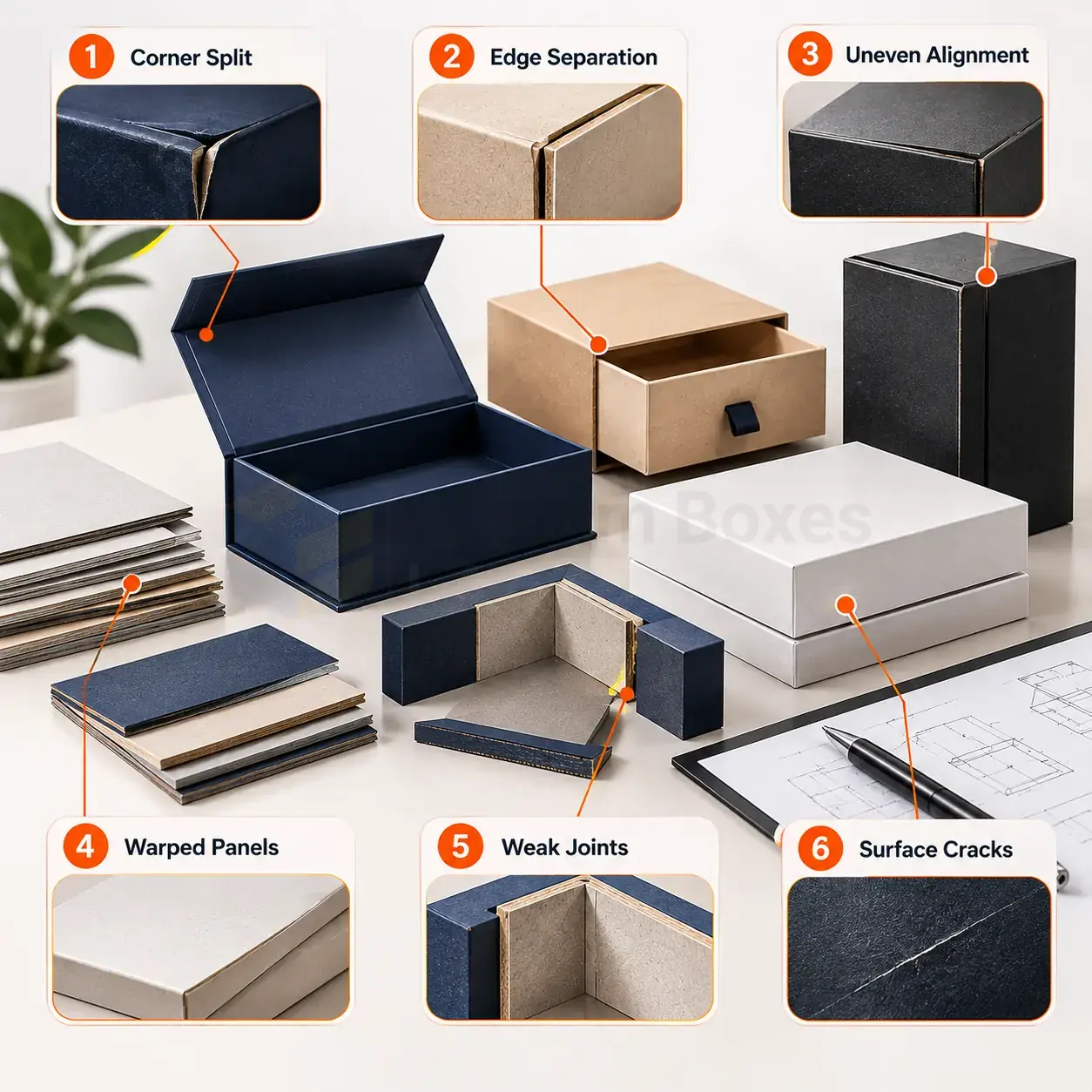
Structural defects affect the shape, strength, and finish of custom rigid boxes. They often develop during board cutting, wrapping, adhesive application, folding, or final assembly. Manufacturers can reduce these problems by checking each production stage instead of relying only on a final inspection.
Corner Pleating
Corner pleating occurs when wrapping paper forms unwanted folds or wrinkles around the edges of a box. These creases make the packaging look uneven and can weaken the quality of its finish.
Common causes
- Incorrect paper dimensions or cutting angles.
- Excessive wrapping material around the corners.
- Poor folding techniques during manual or machine wrapping.
- Uneven adhesive application that prevents the paper from sitting flat.
How to fix it
Manufacturers should use accurate cutting templates and test the wrapping process before starting bulk production. Operators must apply consistent pressure when folding paper around each corner and remove excess material without exposing the underlying board. Adjusting the wrapping machine's tension can also prevent wrinkles.
Misalignment Errors
Misalignment occurs when the lid, base, printed artwork, or decorative elements fail to line up correctly, especially in two-piece rigid boxes. Even a strong box can look poorly made when its components do not match.
Root causes
- Incorrect positioning of the greyboard during assembly.
- Poor calibration of cutting and wrapping equipment.
- Inconsistent placement of printed sheets.
How to fix it
Manufacturers should establish clear alignment marks and use positioning guides during assembly. Regular equipment calibration helps maintain accuracy, while inspection templates allow workers to compare the lid, base, and printed panels against approved samples.
Dimensional Inconsistencies
Dimensional inconsistencies occur when finished boxes differ from the specified length, width, height, or internal space. These variations can cause loose lids, tight closures, poor product fit, and problems during automated packing.
Important causes
- Inaccurate board cutting.
- Variations in board thickness.
- Incorrect measurements in production drawings.
- Poor control of folding and assembly tolerances.
How to fix it
Manufacturers should confirm all dimensions before production and use calibrated measuring tools to inspect finished samples. Production drawings must clearly define internal and external dimensions, board thickness, and acceptable tolerances.
Delamination
Delamination occurs when two bonded layers separate. The problem may appear as lifting paper, peeling laminate, loose board layers, or gaps between wrapped surfaces. It can damage the box's appearance and reduce its durability.
Root causes
- Poor surface preparation.
- Incorrect adhesive selection.
- Insufficient or uneven glue application.
How to fix it
Manufacturers should select adhesives that suit the board, wrapping paper, coating, and finishing materials. Operators must apply the correct amount of adhesive and maintain suitable pressure while the layers bond.
Warping and Curling
Warping occurs when the box bends, twists, or loses its intended shape. Curling often affects paper-wrapped panels, edges, or lids. Both defects can interfere with stacking, storage, and closure.
Root causes
- High or fluctuating humidity.
- Incorrect adhesive distribution.
- Uneven moisture levels in the board and wrapping paper.
How to fix it
Manufacturers should store board and wrapping materials in a clean environment with stable temperature and humidity. Allowing materials to acclimatise before production can reduce sudden moisture-related changes.
Discover Functional Issues to Avoid in Rigid Boxes
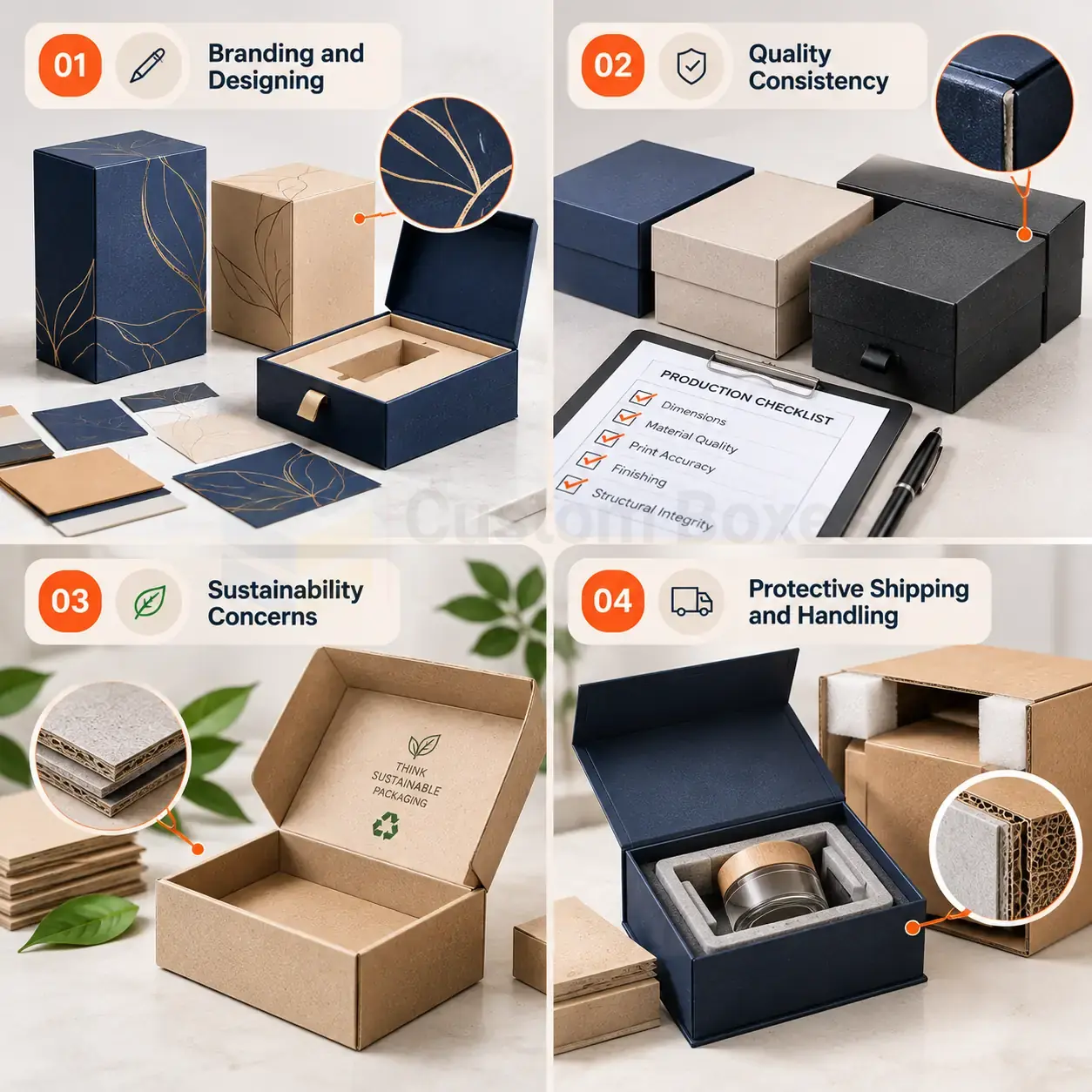
A box may look perfect but still fail to perform as expected. Functional quality depends on closure, product fit, protective strength, consistent construction, and suitability for distribution. Manufacturers must evaluate these factors alongside visual appearance.
Branding and Designing
Packaging should represent the brand accurately and create a consistent customer experience. Poor print registration, faded colours, misplaced logos, and damaged finishes can make elegant boxes look cheap.
Manufacturers should approve a physical sample before bulk production. They should also check colour consistency, artwork placement, text readability, and the compatibility of coatings with the selected materials. A design review should consider how the artwork appears on the assembled box rather than only on a flat print proof.
Quality Consistency
Consistent quality ensures that every unit meets the agreed specifications. Differences in dimensions, colour, adhesive coverage, or closure strength can create customer complaints and increase replacement costs.
Manufacturers should establish written quality standards and inspect materials before production. First-piece inspections, in-process checks, and final sampling help identify defects at different stages. Teams should record recurring issues and use those records to improve machine settings, training, and production methods so that consistent luxury rigid boxes can be created.
Sustainability Concerns
Sustainable packaging requires careful material selection and efficient manufacturing. Excessive glue, unnecessary laminates, damaged board, and repeated production runs can increase waste.
Manufacturers should assess recyclable board options, responsible material sourcing, and finishes that suit the intended recycling route. They should also consider whether coatings, magnets, ribbons, and plastic inserts affect recyclability.
Protective Shipping and Handling
Rigid boxes must withstand the conditions they encounter during storage and delivery. Weak corners, loose lids, crushed panels, and surface scratches can damage both packaging and products.
Manufacturers should evaluate the box's structure against the weight, shape, and fragility of its contents. Protective inserts should hold products securely without applying excessive pressure. Where necessary, the finished collapsible rigid boxes should undergo appropriate handling, stacking, or transport tests.
Where to Buy Error-Free Luxury Rigid Boxes?
If you’re looking for a one-stop shop for buying error-free rigid packaging boxes, reach out to Custom Boxes Lane. With free design support and pre-production, the finalization channel allows us to avoid any type of miscommunication in the whole process.
Also, our rigorous testing and quality assurance post-production steps allow us to manufacture exclusive boxes that your customers will surely love.
Final Words
Resolving quality defects in rigid box manufacturing starts with accurate diagnosis, not repeated repairs. A reliable quality assurance process combines approved samples, documented tolerances, in-process inspections, and final performance checks. It also considers branding, sustainability, product protection, and shipping conditions.
When packaging teams prevent defects early, they reduce waste, protect production schedules, and deliver a better experience to their customers. If you have any queries about rigid boxes or want to buy these boxes, reach out to Custom Boxes Lane today.
Quality standards generally cover dimensions, board strength, surface finish, print accuracy, adhesive bonding, lid fit, structural integrity, and product protection. Manufacturers should set measurable tolerances and inspection criteria based on the box design, intended use, customer specifications, and applicable regulations. There is no single universal specification that covers every rigid box.
Three common defects are corner pleating, misalignment, and delamination. Corner pleating creates unwanted wrinkles in the wrapping paper, misalignment causes components or artwork to sit incorrectly, and delamination occurs when bonded layers separate. Each defect requires targeted checks and corrective action during production.
The manufacturing cost depends on the box's size, board thickness, materials, printing, surface finishes, inserts, closure design, order quantity, and production method. Complex structures and premium finishes usually increase costs. Setup charges, sampling, labour, packaging, and shipping may also affect the final quotation. Requesting a quote based on a complete specification provides the most accurate estimate.
The price of an individual rigid box varies according to its design and order quantity. A simple box made in bulk will generally cost less per unit than a small order featuring custom inserts, magnetic closures, foil stamping, or specialty finishes. Buyers should compare quotations using the same dimensions, materials, printing requirements, quantity, and delivery terms to make a fair assessment.
