

Rigid Box Folding Explained: V-Groove Scoring, Creasing Methods, Fold Styles, and Assembly Steps
Waqas Khan Pitafi 2026-10-22 10:44:00
Table of Content
Luxury items demand exquisite boxes to outshine their presentation and leave a lasting impression. But the key element is the packaging, which must be top-notch as it determines the rest of the factors. Here in this blog, we’ll discuss how to fold a rigid box to assemble it at its best and get the maximum perks out of it.
The Sturdy Construction That Starts the Demanding Game
Standard packaging boxes such as foldable gift boxes or tuck end boxes are simple to assemble as they’re not made from thick material layers. That’s not the case with rigid packaging boxes, as they are built to a different level and feature a distinctive appearance and feel.
Tip: To better understand the structural design and material aspects, read our comprehensive guide on rigid stock.
What is Creasing & Its Common Types for Rigid Packaging Boxes?
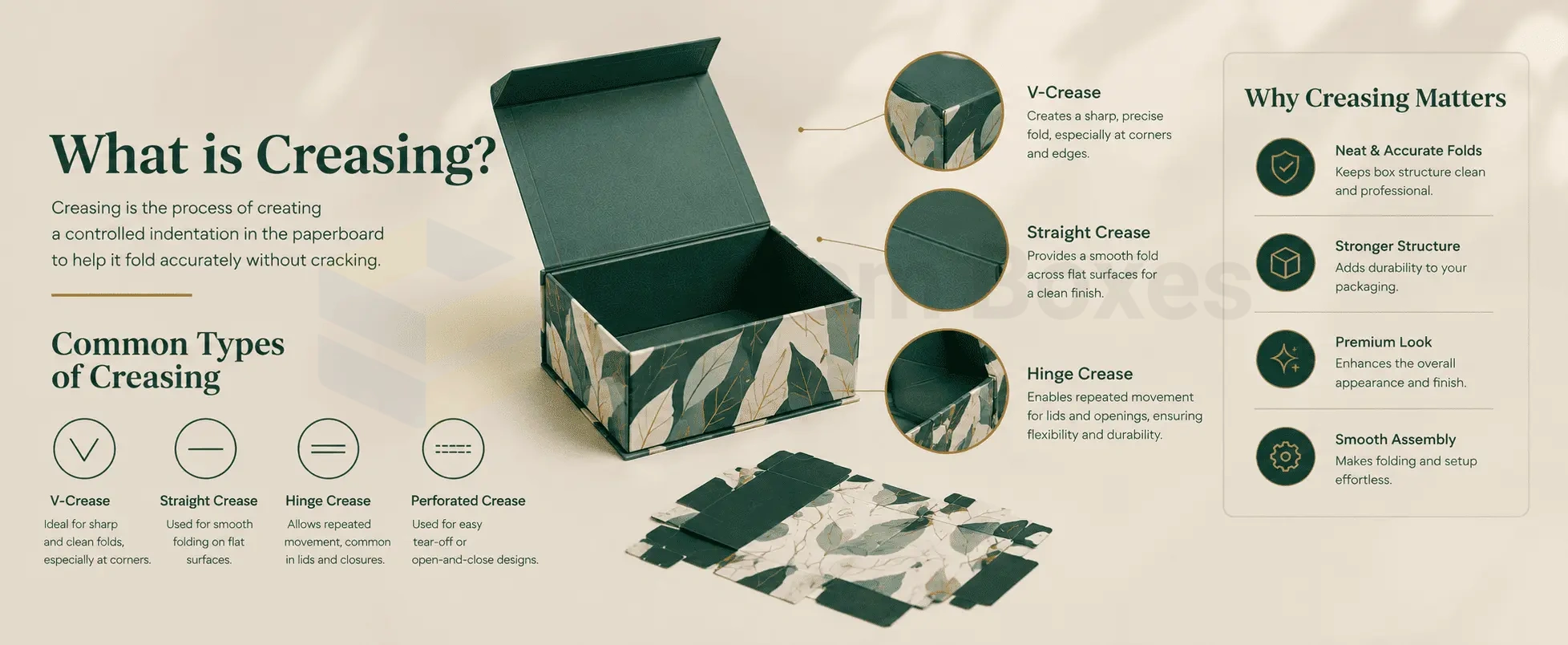
The process of creasing includes the mechanical operation in which the material’s die-line is pressed in a way to develop the foldability later on. While the process is sophisticated followed to ensure there’s no crack occurring in the surface of the material while the box is developed at its best. Some of the common methods and their usages are mentioned in the following table:
|
Method |
Creasing Action |
Best Application |
|
Score |
The blunt wheel compresses fibers without cutting. |
Standard boards (1–3 mm) and clean single folds. |
|
V-Groove |
V-shaped die presses deep groove. |
Thick boards (2–5 mm) and sharp, tight folds. |
|
Double Score |
Two parallel lines create a hinge effect. |
Thick boards (2–4 mm), 180° folds, and lids. |
|
Crush |
Flat blade flattens and crushes fibers. |
Extra thick boards (3–6 mm) and heavy-duty boxes. |
|
Heated |
Heat softens fibers to prevent surface cracks. |
Laminated, coated, or foil-covered boards. |
What are the Folding Styles Available for Rigid Packaging?
There are not only one or two but multiple folding styles used for rigid packaging boxes. Each is picked as per the box’s aesthetics and functionality demands. For instance, some of the popular ones may include the:
- Straight Fold
- Reverse Fold Techniques
- Magnetic Closure Box Folding System
- Collapsible Rigid Box Folding Mechanism
- Two-Piece vs Hinged Lid Folding Structures
Professional-Level Assembly Process of Rigid Boxes
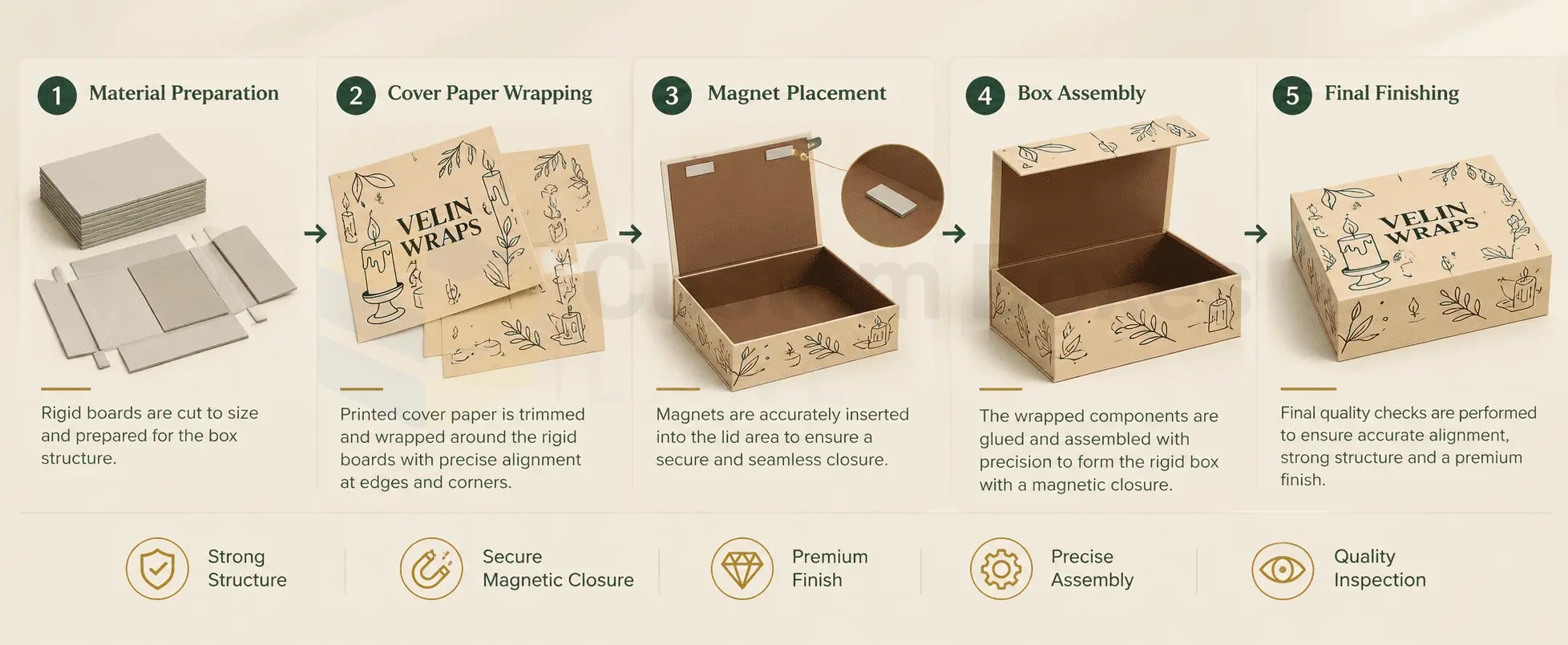 The actual method for the folding of rigid boxes is not so simple, but if it’s being followed in a sequential manner, the outcomes can be ideal. For instance, below are the steps you have to follow to ensure the packaging assembly of rigid boxes is concluded at its best.
Expected Time to Fold a Rigid Packaging Box
The entire timeline to fold a rigid box from start may take from 1-3 minutes or sometimes even more. Individuals who are used to dealing with custom packaging can perform this task in a matter of moments. Those who haven’t done this activity before may require practice to fold the box within a minimal timeframe.
- Die-line Ground Work: First of all, in this step, the ground of the rigid boxes is prepared to create a precise die-line that determines the rest of the aspects for the folding.
- Board Cutting & Wrapping: After that, the material is cut with sharp blades that offer inch-level accuracy, leaving no flaw at all. The box is wrapped from inside out to maximize its appearance and build a reliable packaging solution.
- Securing the Corners: Once done, the box is secured from the corners, and all the panels are assembled with gluing. While the rigid box corner pasting ensures that none of the sides remain under development.
- Final Folding: Lastly, the box’s quality is checked to confirm if it’s optimally secured from inside-out, leaving no assembly flaw at all.
Is rigid box packaging hard to fold?
Rigid boxes are meant to be folded before assembly. Once they’re built, there’s no reserve engineering that can be done on it at all. That’s why the debate of changing its structural features beyond assembly is totally out of the discussion.
The Bottom Line
All in all, we hope you’ve explored and understand the process of folding the rigid boxes and the phases it includes. If you order custom rigid boxes that are not assembled, then it's much easier than doing the whole project from the start. You can reach your trusted packaging by calling us at (904) 899-9020 or writing your concerns to sales@customboxeslane.com for a detailed response.
Creasing involves a sophisticated process to compress and reshape the thick material. In scoring, the paper fibers are removed by rotating blades, which peel the desired layers in a specific area.
The thickness of the board can vary as per the demand for the rigidity of the box. For instance, it ranges from 1.5 mm to 3 mm thick, which approximately translates to 36 pt. to 120 pt. or 1,200 gsm to 1,500+ gsm of material.
One of the main reasons why the wrap cracks is because it cannot bear the stretch pressure. While the material of the box is bent, it breaks easily.
Since the two-piece rigid box contains two individual elements, the base and lid. It doesn’t require any folds to assemble the box’s structure.
Both methods are used to develop rigid boxes. For instance, large-scale orders are managed by machine-level folding, while low-quantity orders can be assembled with manual folding.
